
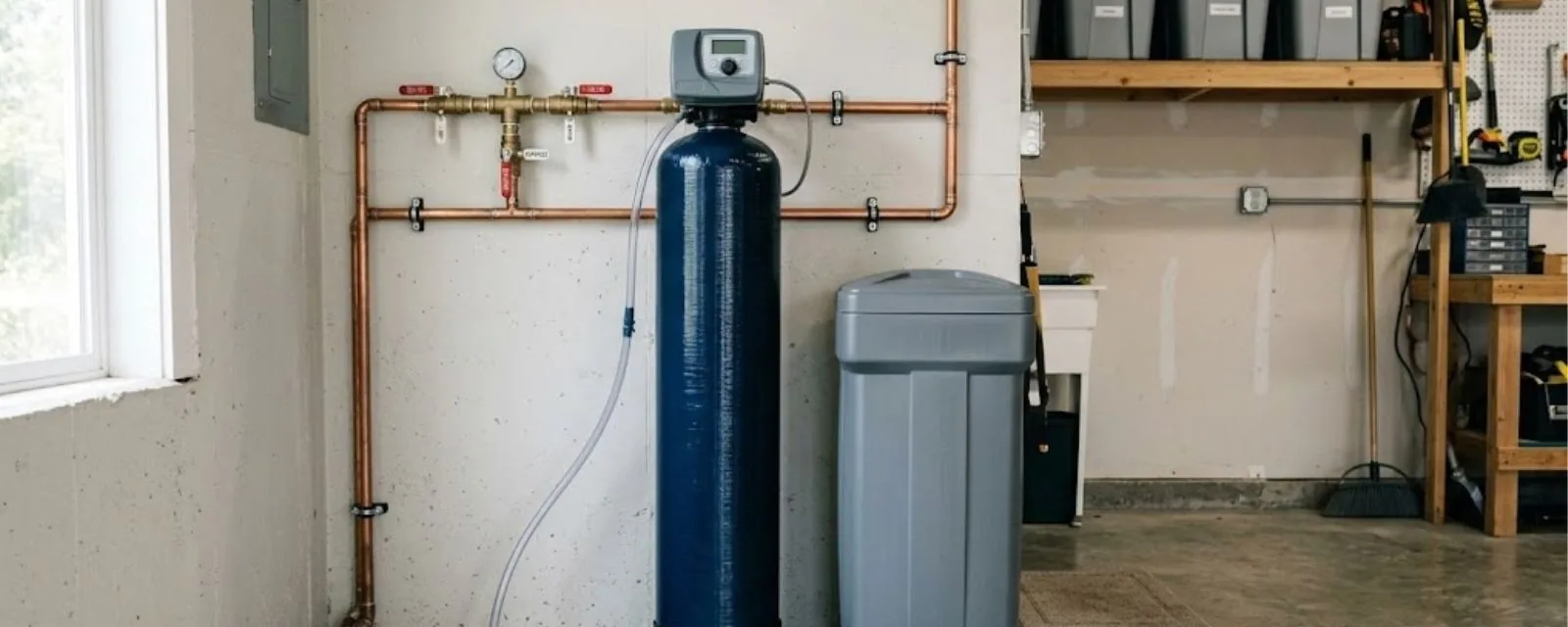
A water softener swaps hardness minerals for sodium or potassium as water passes through a resin tank. Installing one means tying it into the main water line, giving it a drain for the regeneration cycle and giving it power for the control head. It also needs a place for a brine tank and a bag of salt.
Doing it right means choosing the location, sizing the unit and checking local rules before you buy. This guide walks through the steps and the points a La Puente household should confirm first.
Choosing where the softener goes
The unit goes on the main water line after the main shutoff and before the water heater and fixtures, so all indoor taps are softened. Outdoor hose bibs are usually left on hard water, since softened water is not needed for lawns and wastes salt.
Common locations are a garage, a utility room or a side yard in a weatherproof enclosure. It needs level ground, a nearby outlet and access to a drain. Leave space around the tank for salt delivery and service.
Bypass, shutoffs and connections
A bypass valve lets you isolate the softener for service without shutting off water to the house. The plumber cuts into the main line, installs the inlet and outlet connections, adds shutoff valves and connects the softener with flexible connectors or rigid pipe.
Dielectric fittings or approved transitions are used where different metals meet. Poor connections cause leaks and corrosion, so this is not the place to cut corners. Plumbing installation covers related fixture work.
Want a softener sized right?
Call to book a water test and site visit.
The drain line and the air gap
During regeneration, the unit discharges brine and rinse water. That water goes to a drain through a hose with an air gap, which prevents wastewater from siphoning back into the unit. Common drain points are a laundry standpipe, a floor drain or a utility sink drain.
Local rules on softener discharge differ. Ask your water utility and the City of La Puente what applies to you before you choose a model or location.
Power and programming
The control head runs on low voltage from a plug-in transformer, so a standard outlet nearby is usually enough. After installation, the unit is programmed with your water hardness, household size and regeneration schedule. A plumber can test the incoming water for hardness and set the unit.
Setting hardness too high wastes salt and water. Setting it too low leaves scale. A real test of your tap is the starting point.
Sizing the unit to your home
Capacity is rated in grains. Estimate daily grains needed by multiplying hardness in grains per gallon by gallons used per day. The unit should hold several days of capacity so it does not regenerate too often. Oversizing wastes money and undersizing leaves hard water slipping through.
Salt, resin and routine checks after installation
Once the unit is running, the routine is simple. Check the brine tank every month or two and keep the salt level above the water line. Break up any salt bridge, a hard crust that can form and leave the tank without brine. Use the salt type the manufacturer recommends.
Resin wears over many years, and chlorine in the supply can shorten its life. If your water turns hard again even though the unit regenerates, ask a plumber to test the resin and the valve. Keep the manual and the installer's settings sheet in a safe place so any later service starts from the right numbers.
Installation checklist
Confirm these before you buy.
| Item | What to confirm |
|---|---|
| Location | Level space, outlet nearby, room for salt |
| Main line access | Where the line enters the house |
| Drain | Standpipe, floor drain or sink with an air gap |
| Hardness test | Your own test or your utility report |
| Local rules | Discharge rules and any permit needed |
La Puente hardness and what it means for the install
The La Puente Valley County Water District reported average treated-water hardness of 224 mg/L as calcium carbonate in its 2023 report, with a range from 169 to 344 mg/L. At 224 mg/L, that is roughly 13 grains per gallon, which is hard water. The report is the district's own, and your address may be served by another provider.
Check your water bill to see who supplies you, ask that provider for its latest report and test your tap before sizing a unit. A single average hides the range, so a test of your own water is the safer input.
Source type: Published water quality report from the local water district
Frequently asked questions
It is possible with plumbing skill, but cutting into the main line and getting the drain right are where mistakes happen. A licensed plumber does this routinely.
Yes. Regeneration discharges water that must go to a drain with an air gap.
No. A carbon filter handles chlorine taste. A softener addresses hardness.
It depends on hardness and water use. The manual and settings guide it.
Permit rules vary, so ask the City of La Puente Building and Safety Division.
The La Puente Valley County Water District reported an average of 224 mg/L hardness in 2023. Check your provider for your address.
Ready to size a softener? Call and book a water test.
☎ Call (626) 898-6169Where to go from here
Read about water softener and filtration for options and costs. We also serve West Covina and Hacienda Heights.