
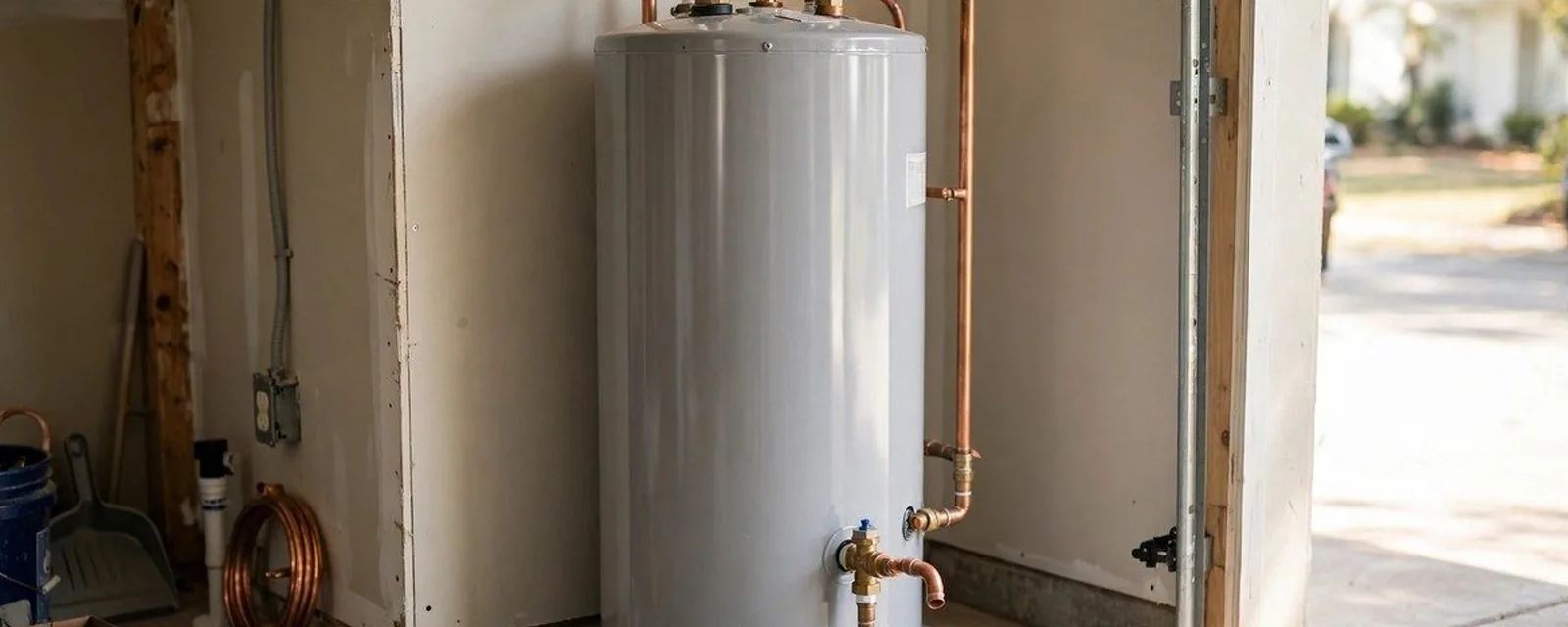
Emergency water heater replacement in La Puente is for the tank that has failed, usually by leaking, and cannot be saved with a repair. The job is to drain the old unit, remove it, set a new one that is sized for your household, connect the water, gas or power, and test it before leaving.
Most of the decisions happen before any tools come out. The size, fuel type, venting and location all affect cost and performance, and getting them wrong means a heater that runs out of hot water or fails an inspection.
When a failed water heater cannot wait
A tank that is actively leaking is an emergency. Water can ruin drywall, flooring and stored items in a garage, closet or utility room within hours, and a pooled floor can reach electrical outlets.
The 24/7 line is answered at all hours, and a dispatcher can arrange replacement the same day when a unit is available. Here is what to do while the call is under way.
What to do before we arrive
- Close the cold water shutoff valve on the pipe feeding the heater. If it will not turn, close the main water shutoff for the house.
- Switch off the breaker for an electric heater, or turn the gas control to off for a gas one. If you smell gas, leave and call 1-800-427-2200 or 911.
- Shut off power to any outlet or appliance standing in water, but only if you can reach the panel without stepping into the water.
- Move belongings out of the wet area and take photos of the damage before anything is cleaned up.
Choosing the right size for your household
A water heater is sized by tank capacity and by how quickly it recovers. A common 40-gallon tank suits a small household, a 50-gallon tank suits a family of four, and a larger family or a home with a soaking tub may need more. A tank that is too small is the most common regret after a rushed replacement.
When the old tank is failing at 2 a.m., it is tempting to match whatever is available. Ask the plumber to show you the first-hour rating on the label of the new unit, because that number tells you how much hot water you get from a cold start.
Gas, electric, tankless or heat pump
Swapping like for like is the fastest route, because the gas line, vent or electrical circuit is already there. Changing fuel type means new venting or wiring and takes longer. A tankless water heater saves floor space and heats on demand, but it needs adequate gas supply or electrical capacity and costs more upfront.
Heat pump water heaters pull heat from the surrounding air and use less electricity than a standard electric tank, though they need room and airflow around them and make some noise. Ask about them if you have a garage or large closet and a long-term plan for the house.
Tank failed? Get it replaced fast.
Call and tell the dispatcher the fuel type, tank size and where the heater sits.
Strapping, expansion tanks and permits
California Health and Safety Code section 19211 requires new and replacement water heaters to be braced, anchored or strapped against earthquake motion, and says the minimum is to secure the unit in accordance with the California Plumbing Code. A replacement should come with proper strapping, not an afterthought.
Permit rules vary, so ask the City of La Puente Building and Safety Division, which handles building, electrical, mechanical and plumbing permits, whether your swap needs one. A plumber who replaces heaters regularly can tell you what to expect and who to call.
What happens to the old tank
The old unit is drained, disconnected and carried out. The plumber should leave the space clean, with the floor mopped and the drain pan or area checked. Ask where the old unit goes. A scrap yard will take the steel, and a reputable plumber handles that as part of the job.
This is also the moment to replace the flex connectors, the shutoff valve and the relief valve discharge pipe if they are corroded. Re-using a rusted shutoff valve on a new tank is false economy, since that valve is what you will need to turn in the next emergency.
Which replacement fits your home
A quick look at the main options and what each tends to suit.
| Option | Best for | Trade-off |
|---|---|---|
| Standard gas tank | Homes with an existing gas line and vent | Needs venting and a clear combustion air path |
| Standard electric tank | Homes without gas, or closets with no vent | Slower recovery and higher running cost than gas in many cases |
| Tankless unit | Households that want endless hot water and space back | Higher upfront cost, may need gas line or panel upgrade |
| Heat pump hybrid | Garages and larger utility spaces | Needs space and airflow, and adds some fan noise |
What affects the cost of water heater replacement
Replacement cost is not a single number. The unit itself, the labor and any code upgrades each move the total, and the plumber should give you one clear price for the whole job.
Insurance note: a failed heater is wear and tear and usually not covered, but resulting water damage from a sudden rupture sometimes is. Keep photos, receipts and the failed unit's label until your claim is settled.
Want your real number?Call (626) 898-6169 for a written price for the whole job before work starts.
How a replacement visit works
Call and confirm the basics
Fuel type, tank size and location are enough to line up the right unit.
Price and approval
You get the full price for the job and approve it before the old tank is touched.
Swap and connect
The old tank is drained and removed, the new unit is set, strapped and connected.
Test and walk-through
The plumber checks for leaks, tests the relief valve and shows you the shutoff.
Replacing a heater in a La Puente home
Many La Puente homes have a water heater in the garage, which can hide a slow leak for a long time. Check the floor near the tank base when you park, because a tank that has been weeping for weeks is closer to failure than one that has just started.
Hard water shortens tank life. The La Puente Valley County Water District reported an average of 224 mg/L hardness in 2023, and heaters on hard water collect scale. A replacement is a good moment to ask about an anode rod check schedule and, if hardness bothers you, a softener. The water softener page explains the trade-offs.
A replacement heater is installed under the California Plumbing Code, based on the Uniform Plumbing Code (UPC), and under California Health and Safety Code section 19211 for earthquake bracing. Electric units also fall under the California Electrical Code, based on the National Electrical Code (NEC).
Water Heater Replacement questions from La Puente homeowners
Yes. The emergency line is answered 24/7, and when a suitable unit is available a licensed plumber can replace a failed tank the same day. Availability depends on stock and on the work involved.
A leak from the tank shell or base is the clearest sign. Rust-colored water, a tank over its expected life and repeated repairs add to the case. A plumber can confirm after a short inspection.
Often yes, if the space and the gas, venting or electrical connections allow it. Ask for the first-hour rating and compare it with how your household uses hot water.
Permit rules vary, so ask the City of La Puente Building and Safety Division. Plumbers who swap heaters regularly know how this works locally.
Ask before the job begins. Removing the old unit is a normal part of replacement, and it should be on the written price.
Replacement means removing a failed unit and putting a new one in its place. Water heater installation covers new locations and upgrades that are planned, rather than a response to a failure.
Want a price before you commit? Call and describe the existing unit.
☎ Call (626) 898-6169If the tank is still working but you are thinking ahead, a planned swap through water heater installation saves the stress of an emergency. If you are not sure the heater is the problem, start with water heater repair. West Covina homeowners can also read the West Covina emergency plumber page.